
Standard Traditional Unicode (InScript) Typing Practice – Learn Nepali Typing Online
Learn Standard Traditional Nepali Typing with NepalType
Standard Traditional typing is a fixed-key Nepali typing method where specific keyboard positions are assigned to Nepali characters, vowel signs, symbols, and Shift combinations. It is useful for users who prefer traditional position-based typing while working with modern Unicode Nepali text. Learning the layout can feel difficult at first, but regular practice helps build finger memory, improve accuracy, and increase typing speed.
NepalType provides free online Standard Traditional typing practice directly in your browser. You can practise individual Nepali characters, common words, sentences, and full paragraphs while tracking your typing speed and accuracy. Whether you are learning the Standard Traditional keyboard for the first time or improving an existing typing skill, NepalType gives you a structured place to practise and become faster, more accurate, and more confident.
Why Standard Traditional Nepali Typing Is Useful Today
Modern Nepali computing relies heavily on Unicode because Unicode stores the actual Devanagari characters rather than depending on a particular legacy font. This allows Nepali text to remain readable and searchable across compatible websites, documents, applications, and devices.
Standard Traditional combines this modern Unicode output with a fixed keyboard layout. Instead of entering Nepali through phonetic English spellings, typists learn specific keyboard positions and gradually develop muscle memory.
This makes the layout useful for people who prefer position-based typing, users working with institutional keyboard requirements, and learners who want a consistent Nepali keyboard for regular practice.
Because different Nepali keyboard layouts can place some characters and symbols differently, users should practise the exact layout required by their workplace, institution, examination, or personal workflow rather than treating every “traditional” keyboard as identical.
Practice Standard Traditional Typing Online with NepalType
NepalType lets you practise Standard Traditional Nepali typing directly in a web browser without installing separate typing-practice software.
Instead of simply looking at a keyboard chart and trying to memorize every character, you can actively use the layout through structured typing exercises. Practice can begin with individual characters and gradually move into Nepali words, sentences, and complete paragraphs.
During practice, NepalType measures important typing results such as speed and accuracy. This helps learners understand whether they are actually improving rather than focusing only on how quickly they can press the keys.
Beginners can use the lessons to become familiar with keyboard positions, while experienced typists can practise longer content and work toward smoother, faster, and more accurate Nepali typing.
Understanding the Standard Traditional Keyboard Layout
Standard Traditional uses defined keyboard positions for Nepali consonants, vowels, vowel signs, punctuation, symbols, and other characters. Some additional characters are accessed through Shift or combinations depending on the layout.
Unlike Romanized Unicode, you do not simply type a Nepali word according to its English pronunciation. You learn which physical keys correspond to the required Nepali characters and use those positions consistently.
Additional Windows vowel shortcuts: Ctrl+Alt+C → आ, Ctrl+Alt+P → ऊ, Ctrl+Alt+] → औ; Ctrl+Shift+O → ई, Ctrl+Shift+P → ऐ, Ctrl+Shift+] → ओ, Ctrl+Shift+Q → ौ. To type र्ई, press Shift+[ for र्, then Ctrl+Shift+O for ई. Shift+O alone still types इ.
Lessons containing characters without a verified input route in this practice layout are hidden in Standard Traditional. They remain available in the other Unicode modes. For missing characters such as ॐ, see the Unicode code and Word Alt+X guide. A decimal number such as 2384 is not a portable Windows Alt shortcut.
Standard Traditional Keyboard Layout
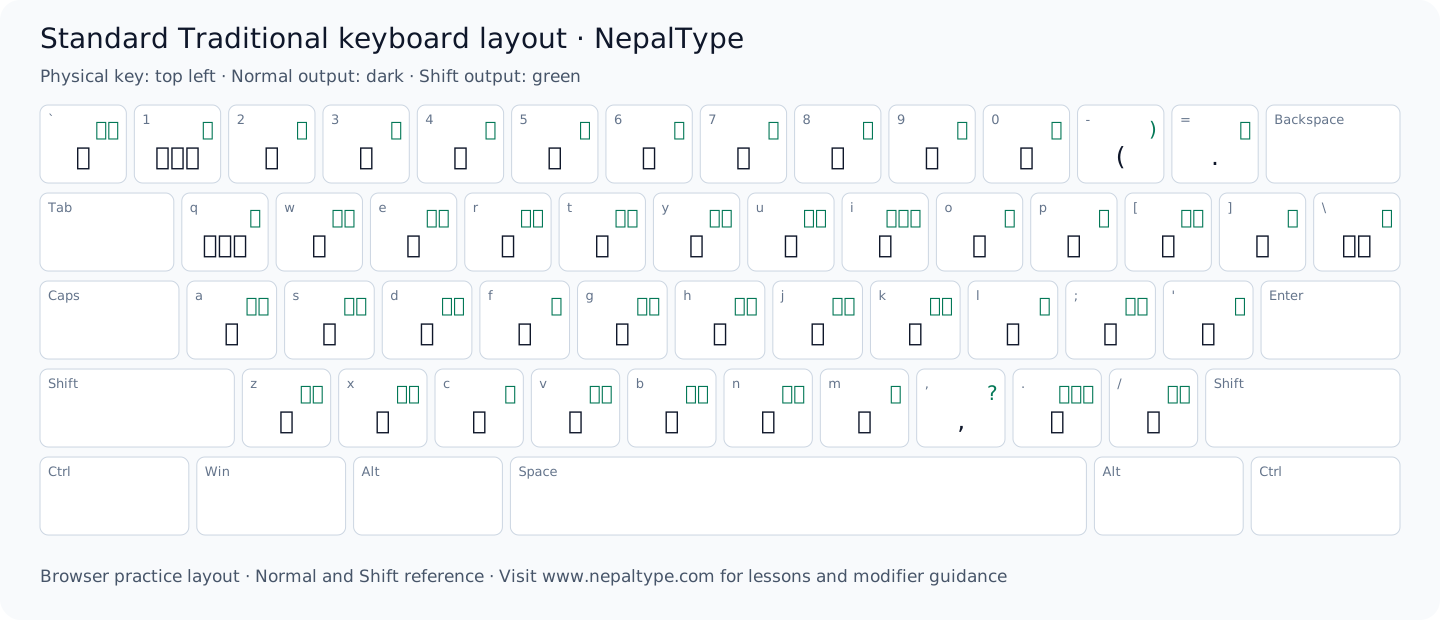
Standard Traditional Nepali keyboard layout showing the Unicode characters assigned to different keyboard positions.
The keyboard may look complicated when you first see all the Nepali characters together. You do not need to memorize the entire layout at once. Regular practice gradually connects each character with a finger movement, making the keyboard easier to use without constantly looking at the layout.
NepalType keeps the visual keyboard available during practice so learners can use it as a reference while gradually becoming less dependent on it.
What Does Standard Traditional Typing Produce?
The important difference between Standard Traditional and a legacy font such as Preeti is what happens after you press the keys.
Standard Traditional produces actual Unicode Devanagari text such as:
नेपाल
नेपाली टाइपिङ
टाइपिङ अभ्यास
नेपालमा नेपाली भाषा
These characters remain Nepali Unicode when copied into compatible websites, documents, messages, and applications. Changing to another Unicode-compatible Devanagari font changes their appearance, but does not turn the underlying text into unrelated English letters.
For exact key positions, use the Standard Traditional keyboard displayed in NepalType’s typing tool above.
Measure progress in this layout
Compare Standard results only with material supported by this layout. An unavailable character is a coverage issue, not a reason to press random keys faster. For an examination or workplace, compare NepalType’s chart with the specified driver and resolve differences before timing yourself.
Who Can Use Standard Traditional Typing?
Standard Traditional typing can be useful for different kinds of Nepali typists.
Beginners can use it to learn a consistent fixed-key Nepali keyboard from the beginning. Students and job candidates can practise it when the layout matches the keyboard system required for their training or examination.
Office and professional users may choose the layout when their workplace or existing workflow uses Standard Traditional typing. Experienced typists can also use regular practice to improve accuracy, maintain speed, or become more comfortable with difficult character positions.
Because the output is Unicode Nepali, the resulting text is also appropriate for many modern digital uses where properly encoded Devanagari is required.
Standard Traditional vs Traditional Unicode
Standard Traditional and Traditional Unicode can appear similar because both are fixed-position Nepali keyboard methods and both produce Unicode Devanagari on NepalType. However, they should not be treated as the same keyboard layout.
Traditional Unicode follows a traditional position-oriented layout intended to provide familiarity for users accustomed to traditional Nepali typing. Standard Traditional follows its own standardized mapping, so certain characters, modifier combinations, punctuation marks, or key positions can differ.
If you practise one layout and then frequently switch to the other, similar-looking keyboards can actually make muscle-memory mistakes more common.
For that reason, NepalType keeps Standard Traditional and Traditional Unicode as separate typing modes. Choose the layout that matches your requirement and practise consistently with that keyboard.
Standard Traditional vs Preeti Typing
Preeti and Standard Traditional may both involve learning fixed keyboard positions, but the text they produce is fundamentally different.
Preeti is a legacy font-based system. The underlying stored characters can be Latin characters or symbols that only appear as Nepali when displayed using the correct Preeti font.
Standard Traditional produces actual Unicode Devanagari characters. Unicode assigns characters such as क, न, and प their own standardized values, making the resulting Nepali text much more suitable for modern digital systems.
This means Standard Traditional is generally more convenient when creating new Nepali content for Unicode-compatible documents, websites, forms, databases, search, or online communication.
Preeti remains useful when a specific legacy document or workflow requires Preeti.
Check Standard Traditional key coverage first
Find each required character on this mode’s Normal and Shift chart before selecting a practice passage. NepalType only shows Standard lessons with a supported entry path. For example, ॐ is not on the current Normal/Shift map; switching to another documented Unicode input method is different from learning a Standard key that does not exist. The character guide explains the distinction.
Common Challenges When Learning Standard Traditional Typing
The most common difficulty for beginners is remembering where Nepali characters are located on an English-labelled physical keyboard. Looking down at the keyboard repeatedly can make typing feel slow at first.
Another challenge is confusing Standard Traditional with other Nepali layouts. A character that appears on one key in Traditional Unicode or Preeti may not necessarily behave exactly the same way in Standard Traditional.
Nepali vowel signs and combined characters can also take time to understand. Unicode stores characters in a logical sequence, while Devanagari shaping determines how they finally appear on screen. For example, the vowel sign ि is visually displayed before a consonant even though Unicode treats it as a combining sign associated with the consonant.
Regular practice with one consistent layout is therefore more useful than frequently switching keyboard systems while learning.
When to move to harder practice
Repeat a comparable exercise until your recurring errors decrease and you can enter its combinations without repeatedly consulting the chart. Then add one source of difficulty: longer text, punctuation, Shift keys or a longer duration. Learning time depends on prior keyboard experience and the consistency of practice; there is no fixed number of days for every learner.
Standard Traditional Typing for Office Work and Examinations
Fixed-layout Nepali typing can be useful in offices, institutions, data-entry work, document preparation, and other environments where a particular keyboard system has been selected.
Some learners may also practise Standard Traditional while preparing for a typing examination or computer-related position. However, candidates should always check the current official syllabus, notice, or keyboard specification before deciding which typing mode to practise.
“Traditional,” “Traditional Unicode,” “Standard Traditional,” and Preeti should not automatically be assumed to mean the same keyboard.
If a requirement specifically names Standard Traditional, practising that exact layout is important because even small differences between keyboard mappings can affect speed and accuracy.
NepalType keeps each typing mode separate so users can practise the keyboard that matches their actual requirement.
Standard Traditional, Romanized Unicode, or Traditional Unicode?
NepalType supports several ways of typing Nepali because one keyboard method does not suit every user.
Standard Traditional uses its own fixed standardized keyboard mapping and produces Unicode Nepali.
Traditional Unicode also uses a position-based keyboard and produces Unicode, but its exact mapping is different from Standard Traditional.
Romanized Unicode uses a defined QWERTY-oriented mapping with more sound-related associations, which can feel more familiar to people accustomed to English keyboards. NepalType’s Romanized mode is still a defined keyboard layout rather than unrestricted chat-style transliteration.
Preeti is a legacy font-based typing system and is mainly relevant where Preeti documents or workflows are specifically required.
The best layout to practise is therefore the one required by your work, institution, examination, or existing typing habits.
Explore Other Nepali Typing Methods
Standard Traditional is one of several typing modes available on NepalType.
If you already have experience with older Nepali typing systems, you can explore Preeti Typing or Traditional Unicode Typing. If you prefer a QWERTY-oriented Unicode keyboard, try Romanized Unicode Typing.
NepalType also provides English Typing Practice, allowing users to develop both Nepali and English keyboard skills on the same platform.
Frequently Asked Questions About Standard Traditional Typing
What is Standard Traditional Nepali typing?
Standard Traditional is a fixed-key Nepali typing method where specific keyboard positions are assigned to Nepali characters and functions. On NepalType, the mode produces Unicode Devanagari text rather than legacy Preeti-encoded text.
Can I practise Standard Traditional typing online?
Yes. NepalType provides Standard Traditional typing practice directly in the browser with character, word, sentence, and paragraph exercises.
Is Standard Traditional the same as Traditional Unicode?
No. Both produce Unicode Nepali on NepalType, but they use different keyboard mappings. Some character positions, modifiers, or symbols can differ, so they are provided as separate practice modes.
Is Standard Traditional the same as Preeti?
No. Preeti is a legacy font-based system, while Standard Traditional on NepalType produces actual Unicode Devanagari characters.
Do I need to install a special font to practise Standard Traditional on NepalType?
No special legacy font is required to use NepalType’s browser-based practice tool. Unicode-capable systems and browsers can display the resulting Devanagari text.
Is Standard Traditional typing suitable for beginners?
Yes. Beginners can start by becoming familiar with small groups of characters and gradually move to words, sentences, and paragraphs. Regular practice makes the fixed keyboard positions easier to remember.
How can I improve my Standard Traditional typing speed?
Focus first on learning the correct key positions and maintaining accuracy. As your fingers become familiar with the layout, practise increasingly longer words, sentences, and paragraphs. Speed generally becomes easier to develop once the correct movements are consistent.
Can I use Standard Traditional Unicode text on websites and documents?
Because the output is Unicode Devanagari, it can generally be copied and used in Unicode-compatible websites, forms, documents, messages, and applications. The requirements of a particular service or institution should still be checked when necessary.
Which NepalType mode should I choose?
Choose Standard Traditional when that exact layout matches your requirement. Use Traditional Unicode when you need its traditional position-based mapping, Romanized Unicode when you prefer its QWERTY-oriented mapping, and Preeti when you specifically need a legacy Preeti workflow.
Start Practising Standard Traditional Nepali Typing
The easiest way to become comfortable with Standard Traditional typing is to use the keyboard regularly rather than trying to memorize the entire layout at once.
Use the NepalType Standard Traditional typing tool above to practise Nepali characters, words, sentences, and paragraphs while following your speed and accuracy.
Start with correct key positions, build consistency, and gradually move toward longer typing exercises as the layout becomes familiar.